As businesses grow, they usually accumulate a patchwork of separate systems — one tool for accounting, another spreadsheet for inventory, a different app for production tracking, and manual processes for procurement and HR.
Each department works in its own silo, and getting a complete picture of the business means manually cross-checking multiple disconnected sources.
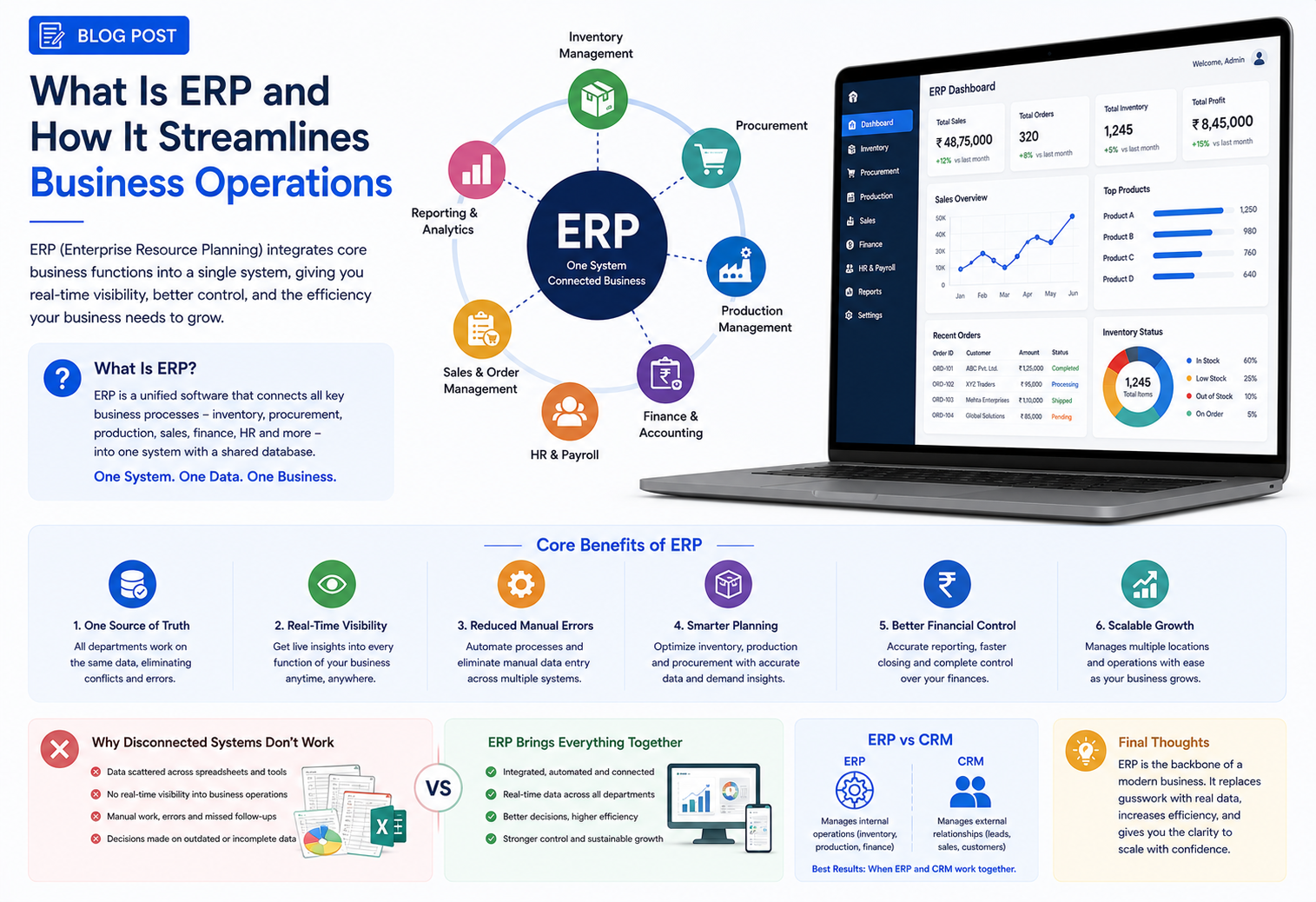
ERP (Enterprise Resource Planning) software exists to solve exactly this problem — by bringing every core business function into a single, connected system.
What Is ERP?
ERP is a unified software platform that integrates core business processes — inventory, procurement, production, sales, finance, and often HR — into one system with a shared database. Instead of each department working with its own disconnected tool, everyone works from the same real-time data.
When a sales order is entered, for example, the ERP can automatically update inventory levels, trigger procurement if stock is low, schedule production, and feed the transaction into financial reporting — all without manual data re-entry across multiple systems.
Why Businesses Outgrow Disconnected Systems
Most businesses don't start with ERP — they start with spreadsheets, basic accounting software, and manual processes. This works at a small scale. But as order volume, product complexity, or team size grows, cracks start to show:
- Inventory counts in the spreadsheet don't match what's actually on the shelf
- Sales teams promise delivery dates without knowing real production capacity
- Finance has to manually reconcile data from three different departments to close monthly books
- Procurement orders raw materials based on guesswork rather than actual demand
- Management has no real-time visibility into what's actually happening across departments
Each disconnected tool creates a small data silo, and small silos add up to a business that's flying partially blind.
Core Benefits of ERP
1. One Source of Truth
Every department pulls data from the same system, eliminating the mismatched numbers and conflicting reports that come from disconnected tools.
2. Real-Time Visibility for Decision-Making
Owners and managers can see live data on inventory, production status, order pipeline, and financials — instead of waiting for someone to compile a report at the end of the week or month.
3. Reduced Manual Errors
Manual data entry across multiple systems is one of the biggest sources of business errors — duplicate orders, mismatched stock counts, missed payments. ERP eliminates most of this by automating data flow between functions.
4. Better Inventory and Production Planning
ERP systems track raw material usage, finished goods, and demand patterns, helping businesses avoid both overstocking (which ties up capital) and stockouts (which delay orders and frustrate customers).
5. Streamlined Financial Reporting
Because sales, procurement, and production data feed directly into the finance module, generating accurate financial reports becomes significantly faster and less error-prone than manually consolidating data from separate systems.
6. Scalability Across Locations
For businesses with multiple branches, warehouses, or production units, ERP provides consolidated reporting and inter-location visibility that would be nearly impossible to maintain manually.
Common ERP Modules
While ERP systems can be customized to a business's specific needs, most include:
- Inventory Management — real-time stock tracking across locations
- Procurement — purchase orders, vendor management, and material planning
- Production/Manufacturing — production scheduling, work orders, and capacity planning
- Sales & Order Management — quotes, orders, and delivery tracking
- Finance & Accounting — invoicing, ledgers, and financial reporting
- HR & Payroll (often integrated or linked) — employee records and payroll processing
Who Needs ERP?
ERP is often assumed to be an "enterprise-only" tool, but the reality is that any business managing physical inventory, production, or multi-department operations benefits from it — including small and mid-sized manufacturers, trading businesses, and multi-location retailers. The signals that a business is ready for ERP include:
- Inventory discrepancies between systems and physical stock
- Departments working off different, disconnected tools
- Difficulty getting a real-time, accurate view of the business
- Manual processes that consume significant staff time every month
- Plans to scale operations, add locations, or increase production complexity
ERP vs. CRM: Not the Same Thing
It's a common point of confusion — ERP manages internal operations (inventory, production, finance), while CRM manages external customer relationships (leads, sales pipeline, customer history). Many growing businesses eventually need both, integrated together, so that a sales order in the CRM flows seamlessly into ERP-managed inventory and production planning.
Final Thoughts
ERP isn't just software — it's the operational nervous system that connects every part of a growing business. It replaces guesswork with real data, replaces manual reconciliation with automation, and gives business owners the clear, real-time visibility needed to make confident decisions.
⚡ For any business currently juggling disconnected spreadsheets and tools across departments, ERP isn't a "someday" investment — it's usually the single biggest lever for operational efficiency available to them.