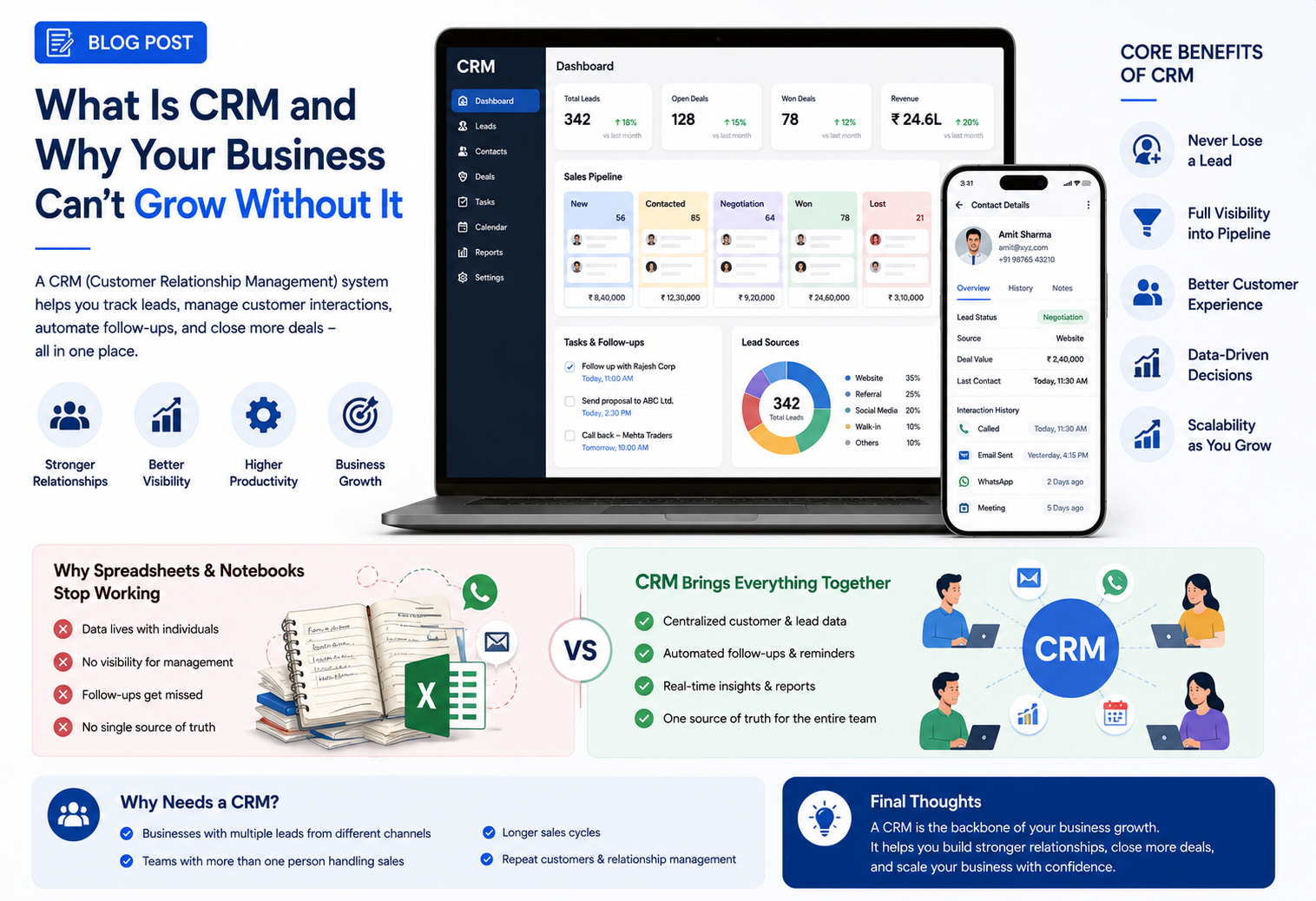
Most growing businesses hit the same wall at some point: leads are coming in, customers are increasing, but nobody can keep track of who said what, who followed up, or which deal is about to close.
Sales get lost in someone's notebook, follow-ups get forgotten, and customer history lives in scattered WhatsApp chats and email threads.
This is exactly the problem a CRM (Customer Relationship Management) system is built to solve.
What Is CRM, Really?
A CRM is a centralized software system that stores and organizes every interaction your business has with a lead or customer — their contact details, conversation history, purchase history, follow-up schedule, and current status in your sales pipeline — all in one place, accessible to your entire team.
Instead of a salesperson relying on memory or a personal spreadsheet, the entire history of a customer relationship becomes visible, searchable, and trackable by anyone in the organization who needs it.
Why Spreadsheets and Notebooks Stop Working
Many small businesses start out managing customers through Excel sheets, notebooks, or scattered notes. This works — until it doesn't. The typical breaking points are:
- Data lives with individuals, not the company. When a salesperson leaves, their knowledge of ongoing deals and customer relationships often leaves with them.
- No visibility for management. Owners can't easily see how many leads are in the pipeline, which are stuck, or which are about to close.
- Follow-ups get missed. Without automated reminders, leads go cold simply because nobody remembered to call back.
- No single source of truth. Different team members have different, conflicting versions of a customer's status or history.
A CRM directly solves each of these problems.
Core Benefits of a CRM System
1. Never Lose a Lead Again
CRM systems automatically track every lead from the moment they enter your pipeline. Automated reminders and follow-up schedules ensure no prospect falls through the cracks simply because someone forgot to call.
2. Full Visibility Into Your Sales Pipeline
Business owners and sales managers get a real-time view of exactly how many leads are at each stage — new, contacted, negotiating, closed-won, closed-lost — without having to ask individual salespeople for updates.
3. Better Customer Experience
When any team member can pull up a customer's complete interaction history instantly, customers get faster, more informed responses — instead of having to repeat their issue or request every time they contact your business.
4. Data-Driven Decision Making
A CRM doesn't just store data — it turns that data into insights. Which lead sources convert best? Which sales reps close deals fastest? Which products or services get requested most? These insights are nearly impossible to extract reliably from scattered spreadsheets.
5. Scalability as You Grow
What works for 20 customers breaks down at 200, and completely collapses at 2,000. A CRM is built to scale with your business, so growth doesn't mean chaos.
Who Actually Needs a CRM?
A common myth is that CRM software is only for large sales teams. In reality, any business that has:
- Multiple leads coming in through different channels (calls, website, referrals, social media)
- More than one person handling sales or customer follow-ups
- A sales cycle longer than a single conversation
- Repeat customers who need ongoing relationship management
...will benefit from a CRM, regardless of company size. This includes real estate agencies, service providers, manufacturers with B2B sales cycles, retailers with loyalty programs, and consultants managing multiple client relationships.
CRM vs. Just "Being Organized"
Some business owners believe they can stay organized without dedicated software. The problem isn't discipline — it's scale. A single founder might manage 15 leads in their head. But once a team of five salespeople is handling 300 active leads across different stages, no amount of personal discipline replaces a system built specifically to track, automate, and report on that volume of activity.
What to Look for in a CRM
Not all CRMs are built the same, and a generic, one-size-fits-all CRM often forces your business to adapt to the software rather than the other way around. When evaluating a CRM, look for:
- Customization to match your specific sales process and industry
- Integration with your existing tools (WhatsApp, email, accounting, ERP)
- Ease of use for your team — a CRM nobody uses is worse than no CRM at all
- Reporting and dashboards that give real, actionable insights
- Scalability as your team and customer base grow
Final Thoughts
A CRM isn't just software — it's the operational backbone of how your business manages its most valuable asset: customer relationships. Businesses that adopt CRM early build a scalable, trackable sales process. Businesses that delay usually end up doing it anyway, just after losing several deals and customers along the way.
⚡ If your business is currently relying on memory, notebooks, or scattered spreadsheets to manage customer relationships, that's usually the clearest sign it's time to make the switch.