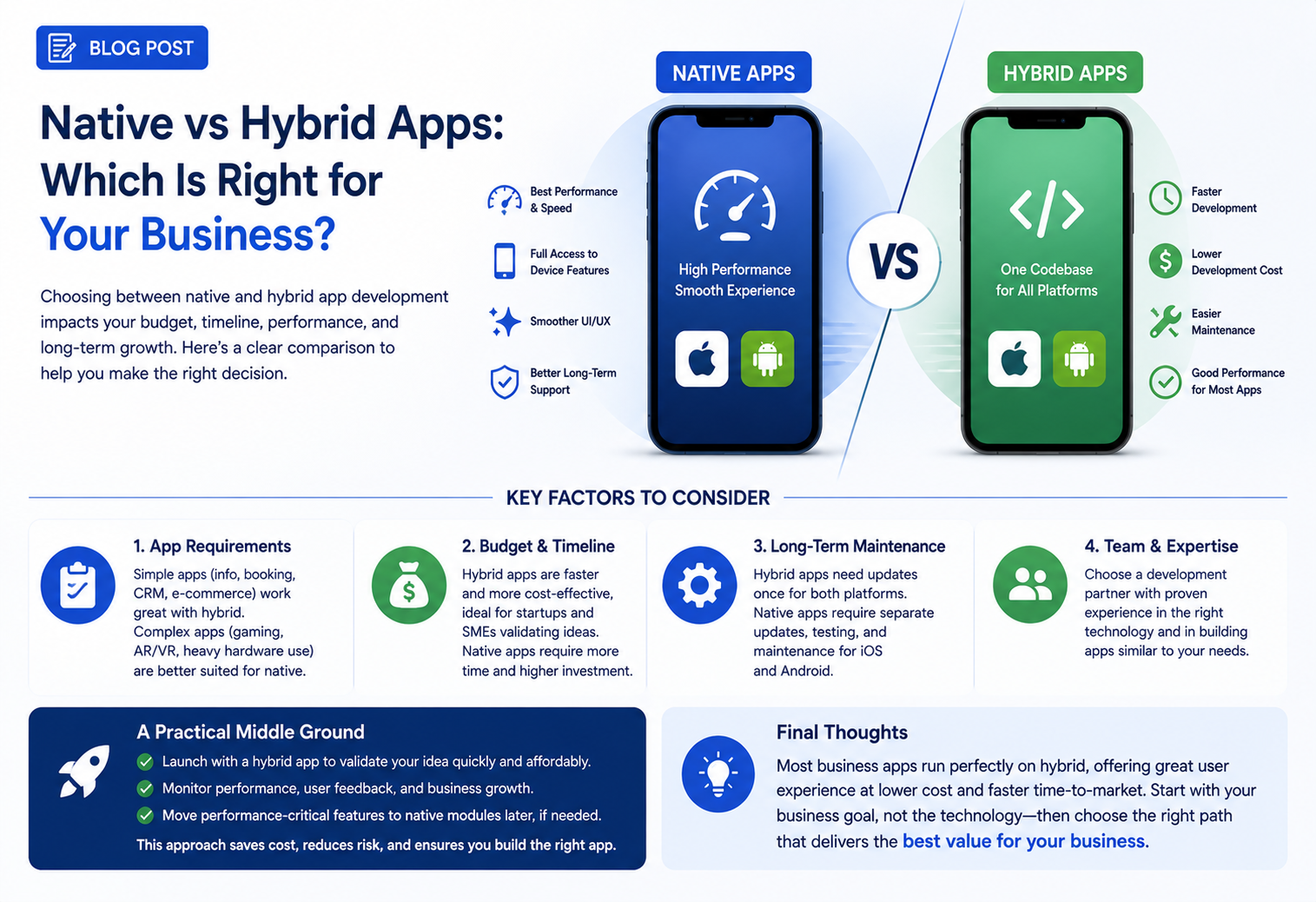
One of the first — and most consequential — decisions in mobile app development is choosing between a native app and a hybrid app.
This decision affects your budget, timeline, performance, and how easily you can maintain and scale the app later. Getting it wrong can mean overspending on complexity you don't need, or under-investing in an app that can't handle your business's real requirements.
Here's a clear breakdown to help you decide.
What Is a Native App?
A native app is built specifically for one platform — either Android (using Kotlin/Java) or iOS (using Swift) — using that platform's own tools and languages. If you want your app on both Android and iOS, you effectively build two separate apps.
Advantages of native apps:
- Best possible performance and speed, since the app is optimized for the specific operating system
- Full access to device features (camera, GPS, sensors, Bluetooth, biometrics) without limitations
- Smoother animations and better overall user experience
- Better long-term support from the platform (Google/Apple) as OS updates roll out
Trade-offs:
- Higher development cost, since you're essentially building two apps
- Longer development timeline
- Two separate codebases to maintain and update going forward
What Is a Hybrid App?
A hybrid app is built once using a shared codebase (frameworks like Flutter or React Native) and then deployed to both Android and iOS from that single codebase.
Advantages of hybrid apps:
- Faster development — one codebase instead of two
- Lower cost, ideal for startups and small-to-medium businesses
- Easier maintenance since updates are made once and pushed to both platforms
- Good enough performance for most business use cases (informational apps, e-commerce, service booking, CRM-linked apps)
Trade-offs:
- Slightly lower performance than native, especially for graphics-heavy or highly complex apps
- Some limitations when accessing very specific or newer device hardware features
- Occasional dependency on the framework's own update cycle
Key Factors to Consider
1. What Does Your App Actually Need to Do?
If your app is primarily about displaying information, taking orders, managing bookings, tracking field staff, or connecting to a CRM/ERP backend, a hybrid app will almost always meet your needs at a fraction of the cost and time.
If your app requires intensive graphics (gaming), heavy AR/VR use, or deep, constant interaction with device hardware, native development is usually the safer long-term choice.
2. Budget and Timeline
Startups and SMEs testing a new business idea or launching their first digital product benefit hugely from hybrid development — it gets a working, professional app into users' hands faster and cheaper, which matters when you're validating demand.
Enterprises with bigger budgets and a clear, performance-critical use case may justify the higher investment of native development from day one.
3. Long-Term Maintenance
Every app needs updates — new features, bug fixes, OS compatibility patches. With native apps, every update needs to be built and tested twice. With hybrid apps, most updates are built once and rolled out to both platforms simultaneously, significantly reducing ongoing maintenance cost and turnaround time.
4. Team and Vendor Expertise
Not every development team is equally skilled in both native and hybrid stacks. When choosing a development partner, ask specifically about their experience delivering apps similar to what you need — not just which technology they prefer to work in.
A Practical Middle Ground
Many growing businesses take a phased approach:
- Launch with a hybrid app to validate the idea, get to market quickly, and keep costs manageable
- Monitor usage, performance needs, and user feedback
- Migrate specific performance-critical features to native modules later, if truly necessary
This approach avoids over-engineering an app before you know exactly how your users will use it.
Final Thoughts
There's no universally "better" option between native and hybrid — only what's better for your specific business, budget, and app requirements. Most business-utility apps (retail, services, logistics, CRM-linked apps, booking systems) run perfectly well as hybrid apps, delivering excellent user experience at a fraction of native app cost and time.
⚡ The right approach is to start with your business goal, not the technology — then choose the development path that gets you there efficiently, without over-investing in complexity you don't need yet.